
Pool
Average the backbone embedding of every policy step over the agent-image, wrist-image and language tokens: a 6144-d vector per step.
Choose a rollout of an unseen task and play it. The probe's state, the scores of three methods and the predicted failure mode follow the video.
The demo could not load its data. Serve this folder over http (for example python -m http.server in website/) instead of opening the file directly.
No alarm
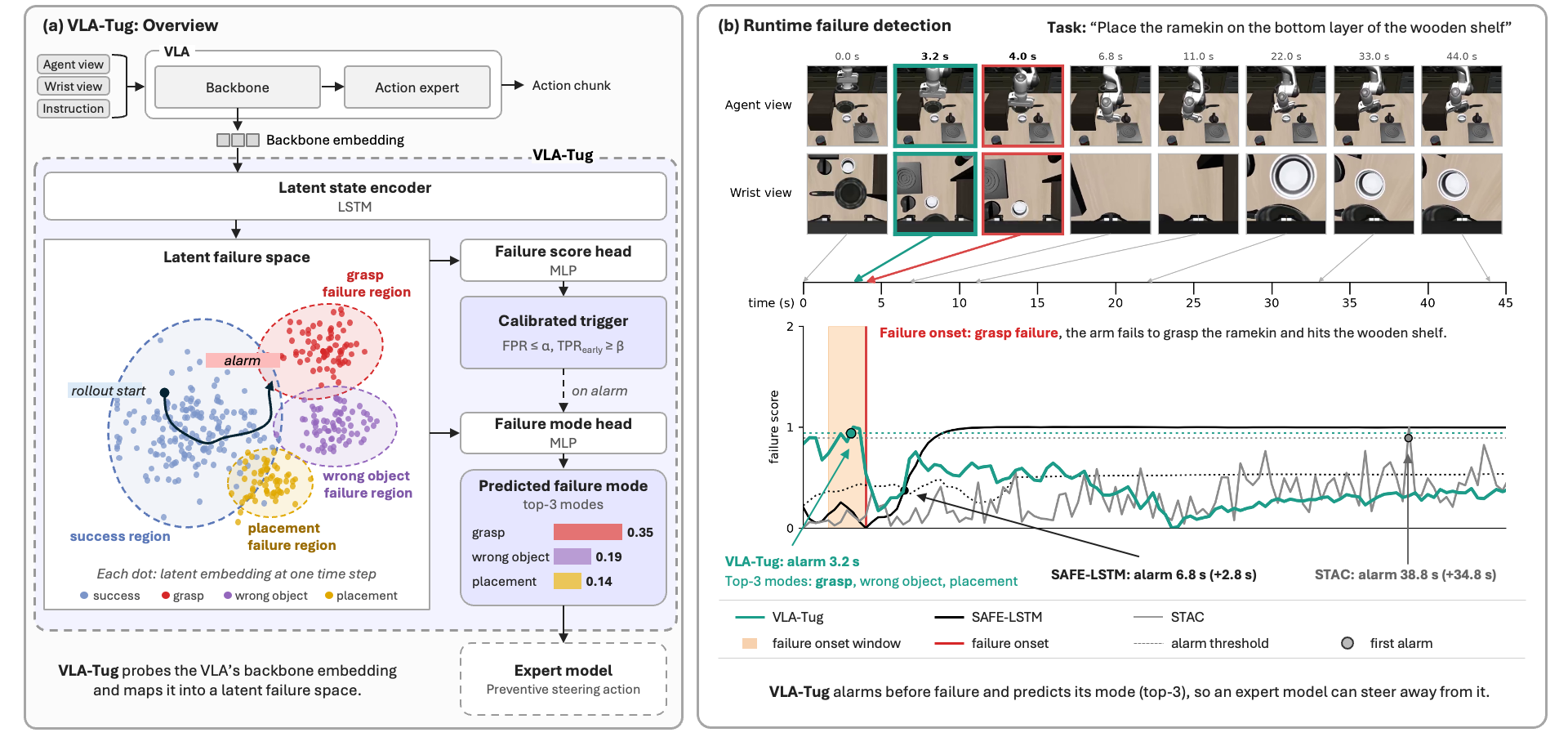
VLA-Tug probes the VLA's backbone embedding and maps it into a latent failure space.
current step VLA-Tug alarm × annotated failure time
alarm dashed line: calibrated threshold annotated failure time and the on-time window before it
Vision-Language-Action models (VLAs) enable general-purpose embodied intelligence, but their performance is brittle under distribution shift, where unanticipated failures can damage equipment or endanger people. Deploying VLAs in real-world systems therefore requires a runtime monitor that is timely, calibrated, and informative while being efficient enough to run on the edge. Existing methods fail to fulfill these requirements. We present VLA-Tug, a lightweight probe over the latent layers of a VLA backbone that improves early failure detection and bounds the missed-detection and false-alarm rates, with minimal inference overhead. We show that supervising on the pre-failure segment of a trajectory increases early failure detection at matched false-positive rates by up to 30% over the strongest learned baseline. Under shift to unseen tasks, the bounds on missed-detection and false-alarm rates remain valid in up to 86% of runs, versus at most 21% for baselines. Unlike existing methods, VLA-Tug predicts the failure mode to enable corrective actions, raising top-3 accuracy on unseen tasks by up to 44% over a majority baseline. We release a dataset of 3,180 annotated manipulation episodes to support future work on latent failure detection in VLAs.
Average the backbone embedding of every policy step over the agent-image, wrist-image and language tokens: a 6144-d vector per step.
Train a probe on the steps that precede a failure: an LSTM over the embeddings with a failure-score head, a failure-mode head and a semantic (CLIP) head.
Set the alarm threshold on held-out rollouts with max-conformal prediction or Learn-then-Test, which bounds the false-positive rate and the early true-positive rate together.
Score against annotated failure times: the area under the early true-positive rate versus false-positive rate curve up to 40%.
TODO: one sentence on the headline result. Numbers must match the paper's tables.
| Method | Cal. | LIBERO-10 π0.5 | LIBERO-10 GR00T | LIBERO-X task | LIBERO-X signature | LIBERO-X skill | Real robot | Cost (LIBERO-X) | |||||||||
|---|---|---|---|---|---|---|---|---|---|---|---|---|---|---|---|---|---|
| 3 seeds | 3 seeds | 3 seeds | 3 seeds | 8 folds | 5 seeds × 8 folds | ||||||||||||
| difficulty * | difficulty * | difficulty * | difficulty ** | difficulty *** | |||||||||||||
| Seen | Unseen | Seen | Unseen | Seen | Unseen | Seen | Unseen | Seen | Unseen | Seen | Unseen | Fit (s) | State (MB) | GPU (ms) | CPU (ms) | ||
| SAFE-LSTM | FC | 75.5±13.4 | 34.9±3.5 | 74.1±13.0 | 51.2±8.4 | 64.6±3.5 | 40.4±2.3 | 64.7±7.4 | 41.2±7.1 | 62.5±2.4 | 30.1±8.5 | 44.5±13.5 | 25.1±18.8 | 43.5 | 26.2 | 0.066 | 0.86 |
| SAFE-MLP | FC | 74.1±2.0 | 39.9±15.1 | 62.9±18.2 | 39.2±9.4 | 59.3±2.0 | 42.3±2.9 | 53.7±2.4 | 46.2±2.3 | 56.8±6.0 | 23.5±12.4 | 40.1±15.9 | 20.2±16.6 | 114.5 | 6.3 | 0.034 | 0.032 |
| STAC | MC | 33.8±5.1 | 36.4±5.3 | 24.2±7.5 | 17.5±9.8 | 21.0±2.3 | 28.0±0.1 | 25.6±3.7 | 28.7±0.3 | 24.6±5.0 | 21.5±8.0 | – | – | 0.0 | 0.0 | 21.30 | – |
| ActProbe | MC | 39.3±11.3 | 26.7±2.6 | 32.4±16.8 | 30.1±9.3 | 12.6±4.2 | 22.7±4.6 | 11.9±3.1 | 13.9±1.5 | 20.3±9.4 | 13.6±7.1 | – | – | 7.1 | 0.09 | 0.15 | 0.11 |
| FailureSpot | FC | 61.9±3.0 | 36.2±21.0 | 36.9±19.8 | 44.7±18.6 | 26.3±2.1 | 20.4±1.2 | 28.0±2.5 | 26.2±5.6 | 30.4±3.4 | 19.6±7.9 | – | – | 9.2 | 6.4 | 0.033 | 0.029 |
| Mahalanobis | FC | 85.7±4.1 | 40.2±15.5 | 70.7±6.4 | 29.2±8.7 | 69.6±6.2 | 30.6±2.2 | 64.4±3.0 | 22.3±4.0 | 71.2±3.1 | 15.9±9.6 | 43.0±16.5 | 19.6±2.5 | 15.2 | 302.0 | 0.41 | 5.37 |
| Euclidean | FC | 73.1±4.4 | 24.2±10.6 | 56.0±6.8 | 23.1±11.4 | 70.5±4.2 | 28.5±3.0 | 65.4±2.1 | 19.7±0.8 | 68.5±4.8 | 19.0±6.5 | 45.1±14.2 | 8.3±12.8 | 0.4 | 3056 | 13.19 | 368.83 |
| PCA-KMeans | FC | 35.7±12.2 | 12.9±5.1 | 44.5±8.7 | 20.0±0.0 | 31.7±3.4 | 25.0±1.2 | 35.3±1.8 | 32.5±1.7 | 37.8±7.7 | 20.7±7.1 | 24.0±11.4 | 19.4±7.7 | 39.9 | 1.6 | 0.12 | 0.055 |
| VLA-Tug (ours) | MC | 75.1±12.5 | 47.9±20.9 | 70.5±10.4 | 47.4±13.5 | 67.9±5.0 | 40.2±1.2 | 67.0±6.6 | 47.0±0.6 | 67.8±4.8 | 39.0±7.0 | 47.6±10.9 | 25.8±11.6 | 6.8 | 26.5 | 0.12 | 0.94 |
Pooled embeddings and annotations of simulated rollouts of two VLAs (GR00T-N1.7 and π0.5) on LIBERO-10 with occlusions and on LIBERO-X, with failure times and failure modes. Dataset: link soon.
The code covers the probe, the calibration (SAFE band, max-conformal, Learn-then-Test), the baselines, the metrics and the scripts that produce the paper's tables and figures.
pip install -e ".[dev]"
python -m cli.download liberox_groot       # pooled features, targets, manifest, splits
python -m cli.train --datasets liberox_groot
python -m cli.evaluate --datasets liberox_groot
python -m cli.figures                      # main table, ablations, curves
These commands are taken from the repository README. During review the code is at the anonymous mirror linked above.
@misc{vla-tug,
  title  = {VLA-Tug: Anticipating When and How Vision-Language-Action Models Fail via Calibrated Latent Probing},
  author = {Anonymous},
  year   = {2026},
  note   = {Under review}
}
TODO: replace with the final entry (authors, arXiv id) once the paper is public.